

Q3 Payments Industry Results: Where the Next Phase of Competition Is Taking Shape
A closer look at Global Payments and Worldpay, Shift4, Fiserv, Toast, Square and Adyen.

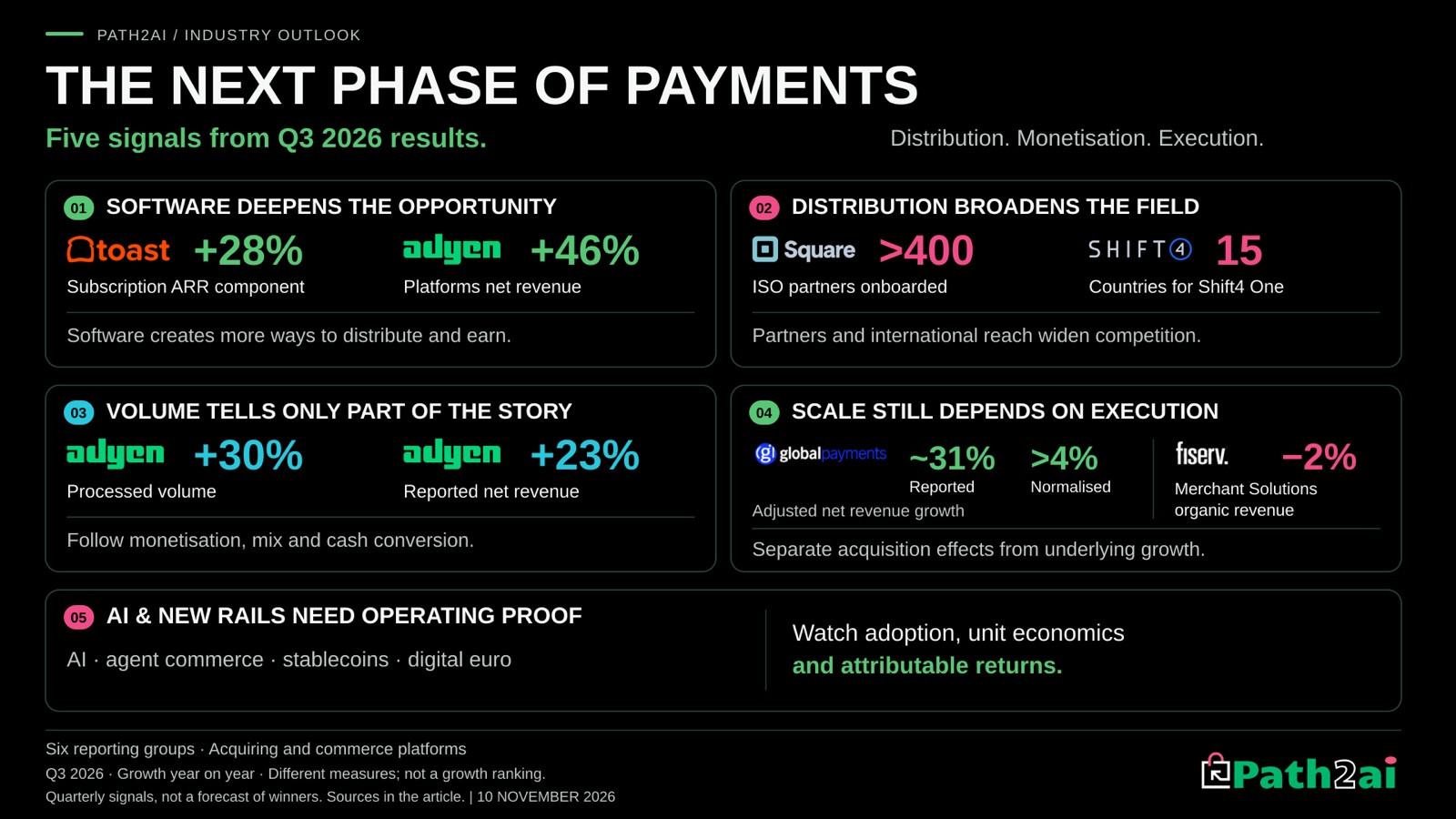
From almost 30 years’ experience in large payments firms, I will say one thing remains consistent: Q3 results are the most important reporting package of the year. For investors, they give you the best early indication of how the year will close. For employees, they can assess how hiring and compensation decisions will go. For operations leaders, they gain insight into what their own opportunities and challenges will become.
The latest payments results offer a useful view of where competition in the market is moving. Software platforms (ISVs) are extending their distribution, large players are integrating acquisitions, whilst others are investing in broader commerce and financial capabilities.
The immediate question is who can turn those trends into sustained growth and attractive economics.
The quarter at a glance
Global Payments [1]
- Adjusted net revenue $3.18bn
- Approximately 31% reported growth; over 4% normalised growth
How to read itWorldpay changes the comparison. Normalised figures adjust the business perimeter.
Shift4 [2]
- Payments volume $61bn, up 11%
- Gross revenue less network fees $648m, up 10%
How to read itPayment volume measures money processed; revenue measures income earned.
Fiserv [3]
- Merchant Solutions organic revenue down 2%
- Group GAAP revenue $5.20bn, down 1%
How to read itThe merchant segment is broader than Clover. Group figures cover additional businesses.
Toast [4] [5]
- Gross payment volume $61.8bn, up 20%
- Annualised recurring run-rate $2.503bn, up 24%
How to read itARR includes subscription and payments components. It is not subscription revenue alone.
Square within Block [6]
- Gross payment volume $76.4bn, up 14%
- Gross profit $1.157bn, up 14%
How to read itSquare figures are distinct from consolidated Block and Cash App results.
Adyen [7]
- Net revenue €738.1m, up 23%
- Processed volume €451.1bn, up 30%
How to read itNet revenue grew 22% at constant currency. Volume and revenue growth differ.
All growth rates are year on year. Figures refer to the quarter ended 30 September 2026, except Toast ARR, which is a period-end run-rate. Company definitions, geography and acquisition effects differ; these figures do not form a like-for-like growth ranking.
Q3 2026 provides signals about that direction, with important limits. These six reporting groups mainly illuminate acquiring and commerce platforms. They do not represent the whole payments market, and they don’t establish a global growth rate, a change in market share or a definitive list of future winners. They can show which business models, routes to market and investment priorities are in the minds of CEOs and deserve closer attention.
1. Software is the route into payments
Toast’s subscription component of annualised recurring run-rate grew 28%, while its payments component rose 21%. Square linked its gross profit growth partly to increased software adoption. Adyen’s Platforms net revenue rose 46%, and Unified Commerce grew 29%. [4] [6] [7]
Taken together, those results indicate that software and platform relationships are being used to create effective distribution and additional sources of income for acquirers. This is evidence of momentum, not direct proof that software caused every point of growth. Participating in more of the commercial activity around a payment, such as billing, lending and other operational services, would enhance growth further.
Also, some statistics on retention, product adoption and customer acquisition economics would tell us more about the durability of this trend.
2. Distribution is becoming more varied and more international
Square reported international payment-volume growth of 26%, including at constant currency, and more than 400 ISO partners onboarded. Shift4 One is now live in 15 countries. These disclosures point to expansion through combinations of self-service, direct sales, partners and international infrastructure. [2] [6]
As discussed earlier, software-led providers are effective distribution channels. A plausible next phase is more competition for productive partnerships and a wider geographic overlap between providers.
Country coverage alone is insufficient: active customers, local economics and repeatable acquisition matter.
Incidentally, Shift4 also lowered its full-year outlook, while maintaining adjusted free cash flow guidance. Expansion remains exposed to trading conditions and execution; it is not a guarantee of accelerating earnings. [2]
3. Volume and monetisation need separate measures
Adyen’s processed volume rose 30%, while net revenue rose 23%. Square, meanwhile, grew gross profit and payment volume at the same 14% rate. [6] [7]
Using those rounded rates, Adyen’s simple net-revenue-to-volume ratio fell approximately 5.4% year on year, implying price pressure for Adyen versus pricing parity for Square. Or does it?
Revenue to volume is a blended indicator, not a price confirmation. Many factors, such as customer mix, product mix, geography, currency and various revenue components, greatly affect revenue and other payments statistics.
Payment volume is an incomplete measure of competitive progress. Providers can add large amounts of volume with very different revenue and profit contributions.
Consider that simply signing one large enterprise partnership or merchant deal could have influenced this, and also that Square’s main target market is SMB, where margins are higher than in enterprise.
Also, look at Fiserv’s results and you immediately assume the processing giant is heading backwards. However, you have to consider that the starting point is over $5bn of segment revenue, far higher than most of the others here. If they get their act together on client acquisition and retention, a 1% shift is a significant sum.
So, you can see that these figures alone, without context, do not establish pricing pressure or gauge true business performance.
For the next growth cycle, the indicators to follow are monetisation within each product and customer segment. Other useful statistics include the contribution from additional services versus core processing. These stats are way more telling and often undisclosed, leaving investors blind to the real growth trends and potential within these businesses.
4. Investment effects on growth
Global Payments’ acquisition and integration of Worldpay illustrates why acquisition effects must be separated from underlying progress.
Adjusted net revenue grew approximately 31% on a reported basis, versus just over 4% on its normalised comparison. Quite the disparity.
Its Worldpay integration expense-synergy target rose to a $650m annual run-rate. It’s important to note that this is a future savings target, not savings already delivered. [1]
Fiserv’s Merchant Solutions organic revenue declined 2%, while management described continued underlying growth at Clover. The company raised its Project Elevate savings target to $1bn.
A platform’s performance and that of the wider group can therefore differ materially; one headline cannot establish that an entire business model is winning or losing. [3]
Adyen is taking a different capital-allocation stance, accelerating investment and setting a 50% expected EBITDA margin for 2026 while discontinuing its medium-term margin objective.
The direction of a margin alone does not tell us whether a business is strengthening: integration savings, weaker trading and deliberate product investment have different implications. [7]
So will payments industry capital investment and M&A continue at the same pace? We think the sector will continue to pursue several paths at once: scale and efficiency, specialised software, and broader platform capabilities.
Announced savings and acquisitions are always headlines, but they need to be assessed alongside organic growth, integration costs, customer retention and cash conversion.
5. Some good investment signals, with financial proof still developing
As you would expect, AI was a central point of focus in many of the reported results.
Toast described new AI agents; Block discussed AI products and stablecoins; Adyen highlighted agentic-commerce work and its participation in a digital euro pilot.
Those are all meaningful disclosures about product direction. However, they failed to quantify how much of this quarter’s growth came from those initiatives, or establish sector-wide returns. [4] [6] [7]
The useful forward indicators from these Q3 disclosures are the use of AI in production adoption, automated payment volume, fraud management and outreach to conversion outcomes.
Measurable productivity gains and separately identifiable revenue or cost benefits are yet to be seen.
These announcements indicate where companies are placing bets. Future disclosures with real operating evidence will show which bets are working.
Conclusion
Q3 has given us some decent indications of how our industry is doing, and some hopeful outlook predictions, with common themes discussed amongst all of these select players.
None of this is ‘news’ as such, but the various players seem to have a firmer line of sight into their own futures, despite the volatile nature of today’s world markets.
All of these players want to be seen as a force in software distribution, and are competing for more ways to reach the right partners and more ways to earn from the activity they support.
The competitive advantage continues to be sought across distribution, software and the services surrounding payment processing, and the intensity of that activity has definitely increased.
Consolidation and being able to offer everything from one source is still the dream! For those of you thinking partnering is the new M&A, keep watching: no amount of integration hassle will stop the acquisition train!
There have been some confident messages in the Q3 headlines, and that may be comforting on the surface.
But we think the quality of growth is significantly more important than its headline rate, and that is yet to be assessed.
This review covers the six reporting groups above, using releases and filings available by 10 November 2026. Worldpay is included within Global Payments, and Square within Block. Stripe, Mollie, SumUp and Dojo are also tracked, but no comparable Q3 2026 financial disclosure was identified for this review. Product announcements and annual figures are therefore excluded from the quarterly comparison.
Primary company releases and regulatory filings. The numbers in square brackets refer to the sources below. Company statements about targets, future performance and deployment are identified as such; the commercial interpretation is Path2AI’s analysis.
- Global Payments Q3 2026 results, 5 November 2026
- Shift4 Q3 2026 shareholder letter, 5 November 2026
- Fiserv Q3 2026 results, 3 November 2026
- Toast Q3 2026 results, 3 November 2026
- Toast Q3 2026 Form 10-Q and ARR definition, quarter ended 30 September 2026
- Block Q3 2026 shareholder letter, Q3 2026
- Adyen Q3 2026 business update, 28 October 2026
Connecting financial institutions, software platforms and the businesses they serve.